Best Job in the World?
January 10, 2008
by Dave Rhea
"Not taking orders" is one of the ways that knifemaker Tom Mayo describes
himself.
"I had to stop taking orders to preserve my sanity," he said from his home in the shadow of Mt. Ka`ala on the island of Oahu in Hawaii. "I am not an organized individual. Not taking orders allows me the freedom to make what I want and not get locked into making the same knife over and over again."
Mayo has a self-effacing quality to his personality that juxtaposes well with his obvious level of talent and the respect his 26 years as a knifemaker brings. In the literal sense, he is at a place in his life where he does not want to be corralled into anything. By no longer taking orders, he can have the freedom to pursue whatever "floats his boat."
"A lot of that has to do with my age," he said candidly. "When I was younger, I had a lot more energy to come in and work 12 or 15 hours at a time, but not anymore. I get tired."
In fact, Mayo had been a bit ill as of late, leading to the extraction of his gall bladder in March. Then he turned 60 in July. "I was feeling pretty stinking vulnerable and I think about dying a lot," he laughed.
Before worrying so much about his mortality, and long before he was a knife guru in the position to have the luxury of not taking orders, he was taking orders of a different kind making surfboards in Hawaii. After moving to Hawaii in 1972 and getting married, Mayo set up shop and catered to tourists and surfers who came through during the surfing season.
"I never really planned to stay [in
Hawaii] but it just worked out
that
way you know how life is. It was a great job for the lifestyle I wanted," he
grinned. "I could work when the waves weren't good, go surfing in the
morning, go to work at 10."
He also tried his hand temporarily at furniture making. Back in the old
days, he said, the surfboard industry was seasonal. In January or February,
tourists went home and business would always get slow.
"So I decided that I needed a hobby where I could make money and had a
couple friends who made furniture, but I never could make money at it," he
said. "Plus, I'd sand surfboards all day, then come home and sand wood, and
I just got tired of doing that. People would ask me [what I did for a
living, and I would tell them I was a really good "abrasive technician".

Mayo began making knives in 1981. By then he was 35 and had been living
in
Hawaii almost a decade. "I started looking around for something I could do
that I was sure I could make some bucks at, that would be fun and that I
could get done fast. I don't have a big, long attention span," he grinned.
Also, he read a Sports Illustrated back then with a story on Blade Magazine
Cutlery Hall-Of-Famer© Bob Loveless. "That was the moment I decided
that I
wanted to be a knifemaker," he enthused.
"After about a year of trial and error, I started buying materials from [Los
Angeles knifemaker] Glenn Hornby," Mayo continued. "After numerous long
talks on the phone, he invited me to come stay at his house for a
couple of
weeks right before the annual
Anaheim Custom Knife Show, the show that was
to become BLADE Show West. "I got the bug and started making knives and
became friends with Glenn. I credit him with showing me how to make a well-made
knife in the Southern California tradition."
Sadly, Hornby died suddenly 12 years ago of what Mayo characterizes as an
"obscure heart condition."
"For the next eight years I didn't go to a show and had just about quit making knives," he continued. "I just wasn't interested in going to shows anymore. [Glenn] and I went to every knife show together. I always used to stay at his house and he would drive me to the show."
Knifemakers Ken Onion and Duane Dwyer eventually encouraged Mayo to start going to the shows again, which got him back on track. Onion also kept telling him to come up with a "signature" Mayo knife, something that anyone from anywhere could tell was made by him.
"I had always wanted to make folders, and had been making a few over the years," Mayo offered. "Jay Harris showed Stanley Fujisaka and me how to make folders one New Year's Day many years ago at Stan's house. Stan went on to make a career out it. I made about four a year." Besides, Mayo noticed that the makers with the big fighters and bowies had to bring piles of suitcases to the shows, while the folder guys brought just one little briefcase. In his typical self-deprecating manner, he admitted, "I guess you could say I'm lazy!"
He worked on a few designs and eventually came up with his first TNT
prototypes. The TNT became the knife that Mayo is identified with and,
thanks to the persistence of his wife of 34 years, Kathy, he finally got a
website which led to the next progression in his career. "Pretty soon I had
more orders than I knew what to do with, and had to stop taking them," he
related.
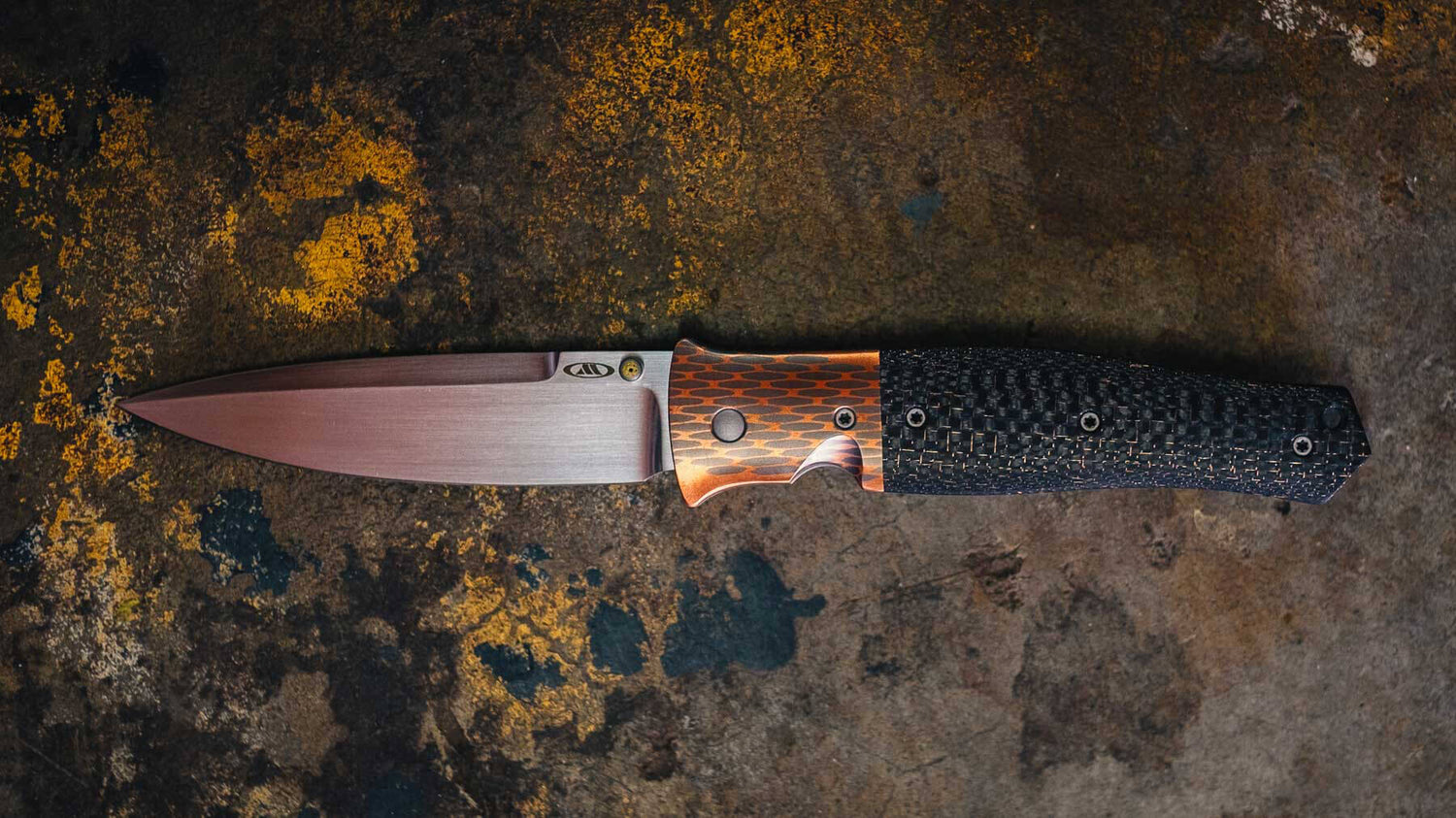
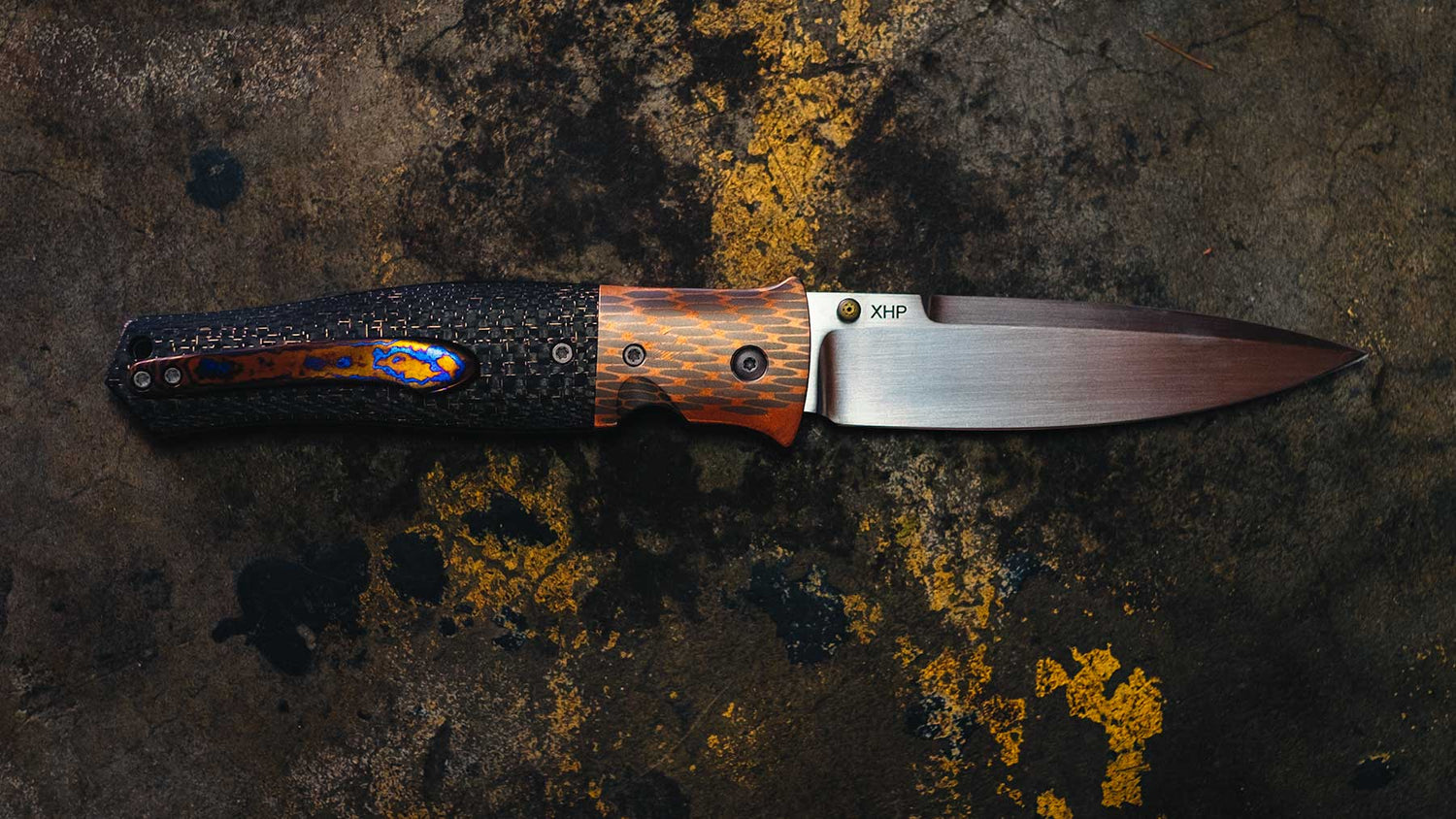
Today, he works with Buck to market mass-production versions of the TNT
folder. He has seven collaborations in all with Buck, each sort of a
facsimile of a TNT, though the latest is a neck knife in CPM S30V called the
Ka`ala after the mountain behind Mayo's house.
Meanwhile, he indicated that he decided recently that Crucible's CPM 154
stainless is best for his handmades.
"As far as the stuff Crucible is coming out with, I'm really just following
the crowd in that. Those guys [at Crucible] are the ones who are really
staying on the leading edge," he praised. "They are constantly coming up
with new stuff. Once those guys started doing [powdered metallurgy steel,
they bumped it up four or five notches as far as how good the material is."
As far as what Mayo is doing now, he said he is getting drawn back to
classic blade shapes, such as clip points, classic bowie shapes, daggers and
drop points. "These knives do the task they were designed for," he reasoned.
"I don't need to look any farther."
Something new for Mayo is a foray into flipper folders. He just made his
first two in collaboration with J.L. "Lee" Williams.
"Tim Galyean [the maker of this issue's cover knife] and Lee are the two
hottest flipper makers right now," he insisted. "They have dialed it in so
good the way they have their frame locks and the way they make their detent
ball fit. It uses quite a bit of force. You yank [the flipper and the blade]
flies out faster than any automatic you've ever held in your life. It's
amazing."
Today, "knife goes on" in Mayo's sharp little corner of the world.
"Being a one-man shop with no helpers and no computerized equipment, I don't put out a lot of knives and am still filling orders from years ago," he observed. "Plus, the time it takes me to get ready for BLADE and the other few shows that I go to every year, there's little time left over to do much besides work. But I still think I have the best job in the world."